Piaget Learning Theory: Phases Of Cognitive Advancement
by TeachThought Staff
Jean Piaget (1896 – 1980 was a Swiss psychologist and one of one of the most prominent figures in developmental psychology.
Piaget is best known for his pioneering deal with the cognitive growth of youngsters. His study changed our understanding of exactly how children find out and grow intellectually. He recommended that youngsters actively create their expertise with stages, each defined by distinct methods of assuming and comprehending the globe.
His theory, ‘Piaget’s phases of cognitive growth,’ has greatly impacted official education and learning, emphasizing the relevance of tailoring mentor methods to a kid’s cognitive developing phase as opposed to expecting all children to find out similarly.
Jean Piaget’s theory of cognitive advancement details a collection of developing stages that youngsters proceed via as they grow and grow. This concept suggests that youngsters actively create their understanding of the globe and distinctive cognitive capabilities and ways of thinking define these stages. The four primary phases are the sensorimotor stage (birth to 2 years), the preoperational phase (2 to 7 years), the concrete operational phase (7 to 11 years), and the official functional phase (11 years and beyond).
See also Degrees Of Combination Of Vital Thinking
A Quick Summary Of Piaget’s Phases Of Cognitive Development
In the sensorimotor stage, infants and toddlers discover the globe through their detects and activities, gradually establishing object permanence. The preoperational stage is marked by the development of symbolic thought and using language, although logical thinking is restricted. The concrete functional phase sees kids start to think more rationally concerning concrete events and things.
Lastly, in the official functional phase, teenagers and grownups can believe abstractly and hypothetically, allowing for more complicated problem-solving and thinking. Piaget’s concept has actually influenced mentor approaches that line up with trainees’ cognitive advancement at various ages and phases of intellectual growth.
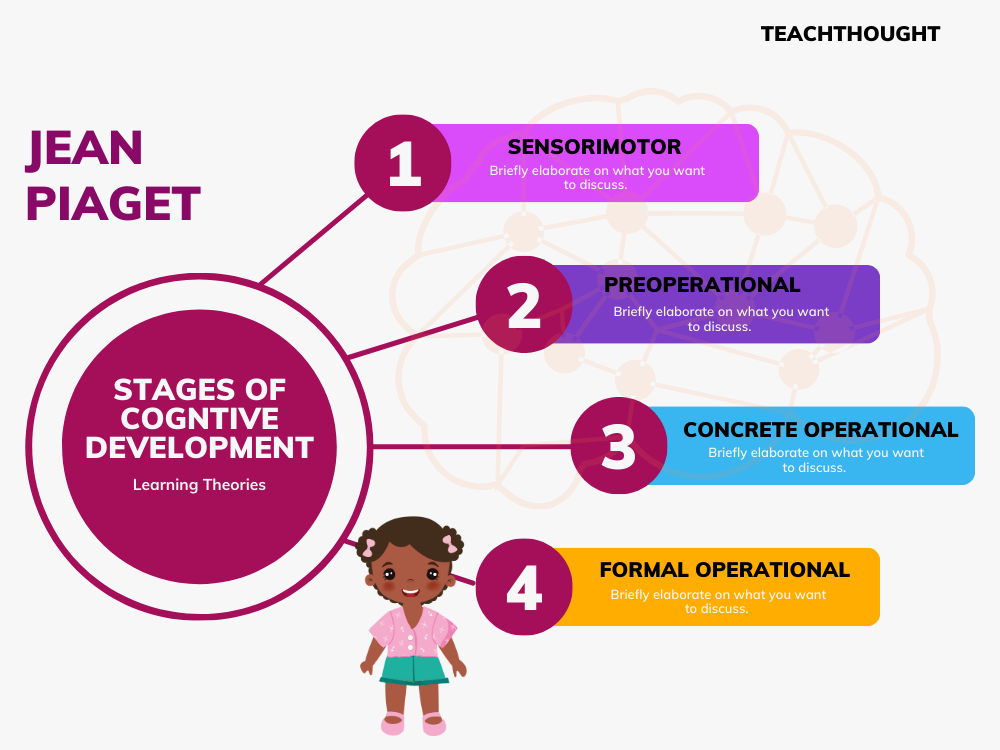
Piaget’s 4 Phases Of Cognitive Advancement
Piaget’s Phase 1: Sensorimotor
Piaget’s sensorimotor stage is the initial developing stage, generally happening from birth to around two years old, during which babies and toddlers largely find out about the world via their detects and physical activities.
Trick attributes of this stage consist of the development of item permanence, the understanding that items remain to exist even when they are not visible, and the gradual formation of straightforward psychological depictions. At first, babies take part in reflexive actions, yet as they proceed through this phase, they start to intentionally collaborate their sensory assumptions and motor skills, discovering and manipulating their atmosphere. This phase is marked by substantial cognitive development as kids transition from purely instinctual responses to a lot more deliberate and worked with communications with their environments.
One example of Piaget’s sensorimotor phase is when a child plays peek-a-boo with a caregiver. In the very early months, a baby lacks a feeling of things durability. When an object, like the caregiver’s face, goes away from their sight, they might act as if it no more exists. So, when the caregiver covers their confront with their hands during a peek-a-boo game, the baby could respond with surprise or light distress.
As the infant proceeds through the sensorimotor stage, usually around 8 to 12 months, they begin to establish item permanence. When the caregiver conceals their face, the baby understands that the caretaker’s face still exists, although it’s temporarily hidden. The child might respond with expectancy and excitement when the caregiver discovers their face, showing their advancing capacity to create mental depictions and comprehend the principle of object permanence.
This development in understanding is an essential feature of the sensorimotor stage in Piaget’s theory of cognitive growth.
Piaget’s Stage 2: Preoperational
Piaget’s preoperational stage is the 2nd phase of cognitive development, generally taking place from around 2 to 7 years old, where children begin to establish symbolic thinking and language skills. Throughout this stage, children can represent items and concepts using words, pictures, and signs, allowing them to take part in pretend play and interact better.
However, their thinking is defined by egocentrism, where they battle to think about other people’s perspectives, and they show animistic thinking, associating human top qualities to inanimate things. They additionally do not have the ability for concrete logic and fight with tasks that require understanding preservation, such as identifying that the volume of a liquid remains the exact same when put right into various containers.
The Preoperational phase represents a considerable shift in cognitive advancement as youngsters transition from standard sensorimotor responses to advanced symbolic and representational thought.
One example of Piaget’s preoperational stage is a child’s understanding of ‘preservation.’
Envision you have two glasses, one high and narrow and the other short and large. You pour the same amount of liquid right into both glasses to have the very same quantity of fluid. A child in the preoperational stage, when asked whether the quantity of liquid coincides in both glasses, could say that the taller glass has even more liquid since it looks taller. This shows the child’s lack of ability to recognize the principle of conservation, which is the concept that even if the look of a things adjustments (in this situation, the shape of the glass), the quantity stays the same.
In the preoperational stage, children are often focused on the most prominent perceptual elements of a situation and deal with even more abstract or logical thinking, making it difficult for them to realize conservation ideas.
Piaget’s Phase 3: Concrete Operational
Piaget’s Concrete Operational stage is the third phase of cognitive growth, commonly taking place from around 7 to 11 years of age, where kids demonstrate boosted logical thinking and problem-solving abilities, particularly in relation to concrete, substantial experiences.
During this phase, they can recognize concepts such as preservation (e.g., recognizing that the volume of fluid continues to be the exact same when poured into various containers), and reversibility (e.g., understanding that an action can be reversed). They can perform fundamental psychological operations like enhancement and reduction. They become extra capable of taking into consideration different perspectives, are much less self-concerned, and can take part in even more organized and orderly mind. Yet, they may still battle with abstract or theoretical reasoning, a skill that arises in the subsequent formal operational stage.
Imagine two the same containers loaded with the same quantity of water. You pour the water from among the containers into a taller, narrower glass and pour the water from the various other into a shorter, wider glass. A child in the concrete functional stage would certainly have the ability to acknowledge that the two glasses still include the same quantity of water regardless of their different forms. Youngsters can understand that the physical appearance of the containers (tall and narrow vs. short and broad) does not change the amount of the liquid.
This capacity to realize the concept of conservation is a trademark of concrete functional thinking, as kids come to be a lot more experienced at logical idea pertaining to real, concrete situations.
Phase 4: The Formal Functional Phase
Piaget’s Formal Operational phase is the fourth and final stage of cognitive advancement, normally emerging around 11 years and proceeding into their adult years. Throughout this phase, people gain the capacity for abstract and hypothetical reasoning. They can resolve complex issues, believe critically, and factor regarding principles and ideas unassociated to concrete experiences. They can take part in deductive reasoning, considering multiple opportunities and potential end results.
This phase permits advanced cognitive capacities like recognizing scientific principles, planning for the future, and pondering moral and ethical problems. It represents a considerable change from concrete to abstract thinking, enabling people to discover and comprehend the world a lot more comprehensively and imaginatively.
An Example Of The Formal Operation Stage
One instance of Piaget’s Formal Operational phase includes a teenager’s ability to assume abstractly and hypothetically.
Imagine providing a teen with a classic ethical problem, such as the ‘trolley trouble.’ In this scenario, they are asked to think about whether it’s morally acceptable to pull a bar to draw away a cart away from a track where it would certainly strike five individuals, however in doing so, it would then hit a single person on an additional track. A teen in the formal functional stage can take part in abstract ethical reasoning, considering different honest concepts and prospective consequences, without counting only on concrete, personal experiences.
They may contemplate utilitarianism, deontology, or other honest frameworks, and they can think of the theoretical outcomes of their decisions.
This abstract and theoretical reasoning is a trademark of the formal functional phase, showing the capacity to reason and reflect on facility, non-concrete problems.
Just How Teachers Can Use Piaget’s Stages Of Growth in The Classroom
1 Specific Differences
Recognize that youngsters in a class may be at various phases of advancement. Dressmaker your teaching to accommodate these distinctions. Give a selection of activities and techniques to satisfy different cognitive degrees.
2 Constructivism
Recognize that Piaget’s concept is rooted in constructivism, meaning youngsters actively develop their understanding through experiences. Urge hands-on knowing and exploration, as this aligns with Piaget’s emphasis on discovering with interaction with the atmosphere.
3 Scaffolding
Be prepared to scaffold guideline. Pupils in the earlier phases (sensorimotor and preoperational) may need a lot more support and assistance. As they advance to concrete and formal operational stages, gradually raise the intricacy of tasks and provide extra independence.
4 Concrete Examples
Trainees benefit from concrete examples and real-world applications in the concrete operational stage. Usage concrete materials and useful troubles to assist them comprehend abstract principles.
5 Energetic Discovering
Promote energetic knowing. Urge students to think seriously, address issues, and make connections. Use flexible questions and encourage conversations that aid students move from concrete thinking to abstract thinking in the formal operational stage.
6 Developmentally Ideal Educational Program
Ensure that your educational program aligns with the trainees’ cognitive capacities. Present abstract ideas gradually and connect new learning to previous expertise.
7 Respect for Distinctions
Be patient and considerate of individual differences in growth. Some students might realize ideas earlier or behind others, which’s entirely normal.
8 Evaluation
Create assessment strategies that match the trainees’ developing stages. Examine their understanding using approaches that are proper to their cognitive capabilities.
9 Specialist Development
Educators can stay upgraded on the current youngster advancement and education and learning research study by attending expert growth workshops and teaming up with associates to continuously fine-tune their teaching practices.